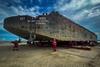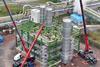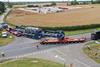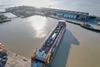





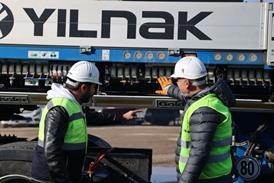
Dutch transport engineering and heavy lifting specialist Mammoet has been providing axle lines for load-in and load-out operations as part of the 3.6 GW Dogger Bank wind farm, offshore UK in the North Sea.

The wind farm is being developed in three phases – Dogger Bank A, B and C – by SSE, Equinor and Vårgrønn. Mammoet has been involved in transporting and weighing the project’s three offshore substations, with critical infrastructure manufacturer Aibel responsible for steel construction of the substations. Fabrication took place at Aibel’s yards in Thailand and Norway.
In Laem Chabang, Thailand, Mammoet provided 338 axle lines to move the approximately 7,500-tonne structures.
Despite each structure weighing roughly the same, a mixture of tidal, engineering and logistical challenges had to be resolved before their load-out and load-in operations. Once configured, SPMTs lifted the substations using their onboard stroke, before they were transferred to or from the ships for onward travel. Tailored grillage beams for the SPMTs were fabricated by Aibel and Mammoet’s engineering teams. Aibel also fabricated two bespoke load-out frames, ensuring the substations stayed in place.
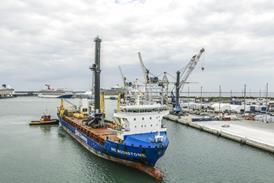
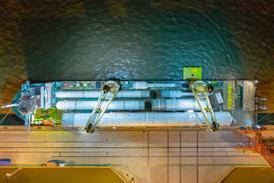
In Thailand, fences at the port had to be removed and a temporary gravel slope constructed so that the SPMTs could avoid using the main entrance. Once inside the terminal, the substations were transported via SPMTs onto a heavy load carrier using ro-ro ramps, with the SPMTs lowering the modules onto the vessel’s grillages before disembarking with the interface beams and the load-out frame. It took 45 to 50 days for each substation to travel from Thailand to Norway.
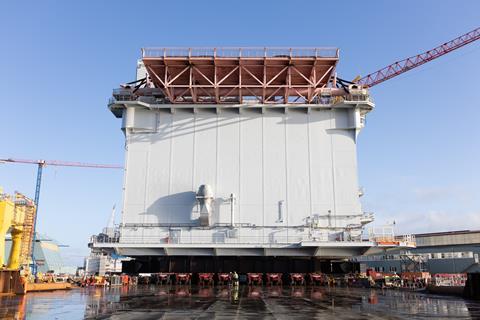
In Haugesund, Norway, 334 axle lines were needed: 264 for the load-in (which involved driving the substations off the vessel and relocating the units onto temporary supports ahead of final fabrication work) and a further 80 for the weighing operations.
A total of 36 weighing jacks and loadcells carried out the weighing operations, which was repeated three times to get an average measurement and establish the final weight and centre of gravity.
After final fabrication work, all 334 axle lines were used to load-out the structures and their final weight of 9,350 tonnes.
Mammoet performed the operation three times over the course of as many years, with learnings applied each time.