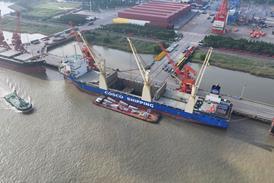

The expansion of wind power across the southeastern Mediterranean has provided a strong new business stream for specialised heavy lift shipping and transport companies in Greece, not least due to the growing capacity and size of installed turbines. Bigger turbines and more complex operations require specialised equipment and staff, explained Elisabeth Cosmatos, ceo of Cosmatos Group.
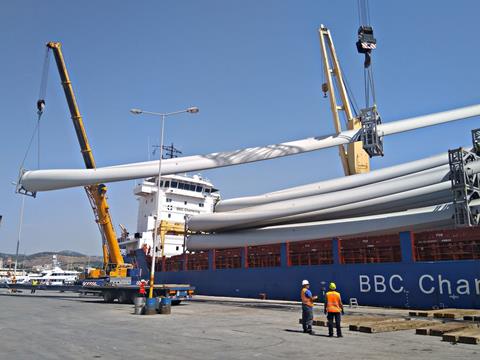
Cosmatos entered the Greek wind energy sector during the early 2000s and its capabilities have evolved with market needs. Since its first projects in Greece – such as the17 ΜW Alogorachi wind farm in Anavra, Almiros, which comprised 20 Gamesa’s G58 turbines – Cosmatos has completed over 30 wind energy projects in the region.
In those early projects, the average power output of a wind turbine was around 850 kW per unit. Nacelle weights were around 24 tonnes and turbine dimensions, including blades, were no longer than 35 m.
The situation today is very different. Now, onshore wind turbines can have capacities up to around 7 MW with tower to hub heights of about 170 m and blade lengths of 85 m. Load weights are also significantly higher.
Along the way, heavy lift companies have had to develop logistics, loading, unloading and documentation services for a new clientele and load types, with equipment manufactured in new locations and often delivered to remote destinations.

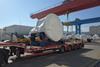
An entirely new market has emerged for inland transport of oversized components, such as blades, towers and generators; customised storage and temporary warehousing solutions; as well as special requirements for vessel loading and delivery using specialised vehicles and escort services. This has also required dedicated equipment such as extendable trailers, blade lifters and modular axle lines.
Specific projects have brought major challenges. A 2018 project to transport 12 sets of EWT’s turbines, comprising 100 units with a total weight of 1,656 tonnes, to the Island of Chios proved particularly complex.
Port handling and land transportation equipment had to be deployed on the remote island to execute the move, and a customised unloading solution was developed that was mindful of tourism, limited storage areas, narrow roads and strong winds.
Border challenges
Cross border movements can also be challenging. For instance, Cosmatos managed the first wind farm project in North Macedonia during 2013 and 2014 for Siemens, requiring the transport of 16 sets of wind turbine generators on six vessels to Thessaloniki.
From there a total of 194 units weighing 2,751 tonnes had to be moved to the construction site at the Bogdanci wind energy park in North Macedonia. This involved managing special permits for the oversized cargo, which had a volume of 20,913 cu m, in both countries and 24/7 fleet monitoring for coordinated movement through border checkpoints and Customs formalities.
Greece’s total wind power capacity reached just over 5.5 GW at the end of June 2025, according to figures from the Hellenic Wind Energy Association. Moreover, new wind farms with a capacity of 1 GW are either under construction or have been contractually agreed, with the vast majority expected to be connected to the grid within 18 months. An additional 300 MW of projects are in the pipeline, according to the association.
Greece has outlined a vision for the Aegean Sea becoming one of the highest wind energy producing regions in the EU. It is targeting the integration of 2 GW of wind energy by 2030, with plans to expand this to 10 GW by 2040.
For Cosmatos, understandably, Greece remains a primary focus, alongside North Macedonia and Cyprus. As investments in wind energy continue to grow across Southeast Europe, it is also expanding its geographical footprint.
The widening regional spread of projects with developments in more remote or mountainous areas requires extra planning to deal with narrow and steep routes or construction site, with all the permits needed ahead of transportation.
Both factors have required the company to strengthen partnerships with local subcontractors and authorities to optimise permitting and support processes. Investment in monitoring technologies and logistics systems to provide real-time updates to clients and stakeholders has also been necessary.
Opportunities offshore
Last year nine southern European Union countries pledged to transform the Mediterranean region into a hub for renewable energy. Cyprus, Slovenia, Malta, Croatia, Greece, Italy, France, Portugal, and Spain committed to work together on cross-border projects focusing primarily on offshore wind.
The spread of offshore wind farm development will only heighten the challenges and the level of specialised transport infrastructure that will be required for moving offshore turbines with capacities up to 15 MW.
Even more, it will be essential to adopt an A-Z approach to projects, handling everything from factory to construction site, and ensuring full coordination between different modes of transport. Experience and specialisation, flexibility in adapting to client needs with tailor-made solutions, and reliability and commitment to safety are all key starting points for wind projects.