
Following its session in London from January 19-23, the International Maritime Organization (IMO) has finalised a draft workplan to develop a safety regulatory framework for ships using new technologies and alternative fuels to reduce GHG emissions.
With the draft workplan set to be submitted to the Maritime Safety Committee (MSC 111) for approval in May 2026, the action plan will involve developing or amending existing safety regulations that are under the purview of the IMO’s Sub-Committee on Ship Design and Construction (SDC). These relate to nuclear power, wind-propulsion and wind-assisted power, lithium-ion batteries and swappable battery containers on ships.
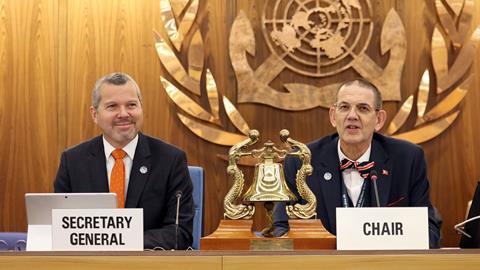
Once the draft workplan is approved the MSC, IMO will work towards the adoption of amendments to SOLAS regulation II-1/41 to allow for batteries to be used as the main source of electrical power and lighting systems (MSC 111); the approval of interim guidelines for the safety of ships using wind propulsion and wind-assisted power (MSC 116); and the adoption of the revised Nuclear Code and amendments to SOLAS chapter VIII (MSC 118). IMO secretary-general Arsenio Dominguez labelled the completion of the workplan a “major achievement”.
Moreover, the SDC further progressed the work relating to the reduction of underwater radiated noise from commercial shipping. Approved in 2024, the three-year experience-building phase for this has now been extended for a two more years – with a target completion year in 2028.
The SDC also agreed to the draft technical guidance on co-optimising energy efficiency and underwater radiated noise at the design and retrofit stage. The sub-committee has requested the IMO secretariat to assess options to cover the cost of the study, with the study expected to generate in-water estimates and help determine an underwater radiated noise baseline for ships.
HLPFI reported in October that the IMO’s net-zero shipping talks had been delayed until this year.