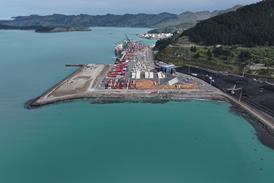
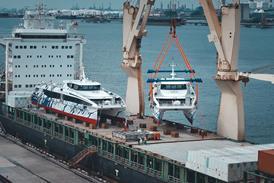
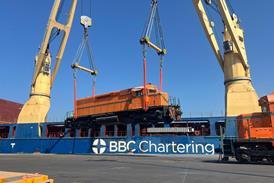



Logistics provider and stevedoring company Italian Shipping & Logistics Agency (ISLA) has been busy supporting wind energy projects at ports across Italy. At the port of Augusta, plans are afoot to transform the port into a major Mediterranean hub for offshore wind logistics and project cargo.
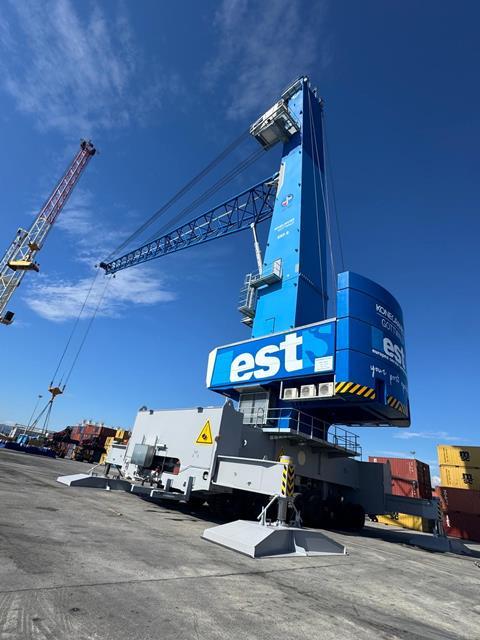
ISLA has stevedoring licences in eight ports across Italy – including Vasto, Catania, Porto Empedocle, Mazara del Vallo, Trapani, Termini Imerese and Augusta – and is active across all major Italian ports through its operational terminals and its extended network.
The company and its subsidiary, port terminal operator Europea Servizi Terminalistici (EST), are currently developing their capabilities at the port of Augusta, which is one of two ports designated by the Italian government for offshore wind development funding. Under this programme, the port of Augusta will receive EUR50 million (USD58.5 million), with the port of Taranto receiving EUR28 million (USD32.7 million).
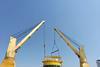
Pietro B. Coniglio, managing director at ISLA, said: “At the moment we are performing heavy lifts of wind-related and other project cargo specifically in Augusta, where we have four cranes: two SP.8 150-tonne capacity Konecranes Gottwald cranes, and two Fantuzzi Reggiane 100-tonne cranes.
“We are already looking at new cranes – we will probably add one or two units with slightly higher capacities. One will likely be another 200-tonne crane, and we are also evaluating a 300-tonne crane.”
Further changes are in the pipeline. ISLA is currently designing a new layout for the Augusta port area as part of its plan to integrate, over the next few years, a dedicated range of offshore wind activities within its existing operations. One phase of the project will involve investing in high-capacity cranes.
A key advantage of the port of Augusta, according to ISLA, is that it already offers sufficient space for the transhipment of heavy lift cargo from one vessel to another, which helps optimise the logistics of transporting onshore wind turbine components to their final destinations.
“The turbines need to reach the nearest port facility to their wind farm, in order to minimise the impact on the logistics and the civil works needed en-route,” said Coniglio. “This means that we’re opening very minor, small regional ports, which have really shallow drafts. For example, we opened the port of Mazara del Vallo a few years ago, where there’s only one berth of 108 m and a maximum draft of 4.3 m. Of course, it would be impossible to get in with a heavy lift vessel in this kind of port, so we needed to find a solution for onshore wind components with minimum deviation for the mother vessels.”
ISLA’s approach is to use Augusta as the main hub, which is large and deep enough to allow wind turbine cargo to be brought in on larger vessels, and then be transhipped to smaller vessels that are suitable for the smaller ports.
“However, the port of Augusta has much more potential, namely as a central hub for the developing offshore wind industry,” Coniglio continued. “The port has a draft of 14.5 m and our dedicated berth is 450 m, which means we are capable of receiving two vessels at a time.”
Therefore, Coniglio said, “we are focusing on pushing the port of Augusta to become one of the prime transhipment hubs for project cargo, and specifically for offshore wind turbines destined not only for project sites in Italian waters, but throughout the entire Mediterranean.”